

A British ambassador to Israel warned as early as 1980 that Israel would detonate a nuclear bomb in case of a new war with the Arabs, according to previously secret state documents released yesterday.
“If they (Israelis) are to be destroyed, they will go down fighting this time. They will be ready to use their atomic weapon,” ambassador John Robinson wrote in a cable to the Foreign Office on May 4, 1980.
Israel has never confirmed or denied having atom bombs under a policy of ambiguity to deter numerically superior foes.
Robinson’s message, published under a rule that allows official British papers to be released after 30 years, voiced concern that US-hosted negotiations would not lead to a comprehensive agreement on the Middle East conflict.
“As long as there is no agreement on the West Bank and Jerusalem which satisfies the Palestinians, they will be driven increasingly to extremism; moderate governments in the area and Western interest will be increasingly threatened; opportunities for Soviet influence and intervention will increase; and so will the danger of a new war,” the cable said.
Saturday, January 1, 2011

Russia’s Khodorkovsky sentenced, West concerned

Former tycoon Mikhail Khodorkovsky’s jail term was extended until 2017 yesterday when he was convicted of theft and money-laundering in a trial condemned in the West as politically motivated.
With Khodorkovsky and co-defendant Platon Lebedev watching from a glass-walled courtroom cage at the close of their trial, the judge said there was no way they could be reformed without “isolation from society.”
Russia’s leading human rights activist called the sentence “monstrous” for the defendants and their country, and the United States said it appeared to result from “an abusive use of the legal system for improper ends.”
Moscow judge Viktor Danilkin granted the prosecutors’ request and ordered Khodorkovsky serve 14 years in prison, including his current eight-year term and counting from the day of his arrest at a Siberian airport in October 2003.
Khodorkovsky, once Russia’s richest man and head of the now defunct Yukos oil company, is in the final year of an eight-year sentence imposed after a politically charged fraud and tax evasion trial that marked one of the defining acts of Vladimir Putin’s 2000-2008 presidency.
Russia has told the West to mind its own business and rejected as “groundless” US suggestions that the verdict resulted from selective justice.
“We remain concerned by the allegations of serious due process violations, and what appears to be an abusive use of the legal system for improper ends,” State Department spokesman Mark Toner said.
A senior official in President Barack Obama’s administration said the verdict would complicate Russia’s bid to join the World Trade Organisation — an effort Obama has supported as part of a “reset” that has improved Russian-US relations.
“It is not going to help their cause, it is only going to complicate their cause,” the official said.
“The impression remains that political motivations played a role in this trial,” German Chancellor Angela Merkel said in Berlin. “This contradicts Russia’s frequently repeated intention to pursue full adoption of the rule of law.”
One of the young tycoons who built fortunes after the Soviet Union’s 1991 collapse, Khodorkovsky fell out with Putin’s Kremlin after airing corruption allegations, challenging state control over oil exports and funding opposition parties.
Dressed in black, Khodorkovsky, whose previous sentence was due to end next October, stood stunned as Danilkin announced the sentence, which his lawyers said was made under pressure from Prime Minister Putin.
“May God damn you and your descendants,” Khodorkovsky’s mother, Marina, shouted at the judge’s back as he hurriedly left the courtroom immediately after the sentencing.
Khodorkovsky had adamantly denied the charges, and supporters said the conviction made a mockery of Russian President Dmitry Medvedev’s pledges to improve the rule of law.
“Our example shows that in Russia, you cannot hope the courts will protect you from government officials,” Khodorkovsky and Lebedev said in a statement read out by lead lawyer Vadim Klyuvgant after the sentencing.
“The sentence was clearly issued under pressure from the executive authorities, headed as before by Mr. Putin,” said Yuri Shmidt, another lawyer on the defence team.
“Putin signalled to the court who is the boss today and who today decides Khodorkovsky’s fate and life,” he said.
“This sentence is monstrous for these two honourable people and for the country,” Lyudmila Alexeyeva, a Soviet-era dissident and Russia’s most prominent right activist, told Reuters.
“The fate of Khodorkovsky and Lebedev and the length of their imprisonment depend on how long Putin stays in power.”
Putin made no public reference to the sentence, and his spokesman declined to comment. President Medvedev also made no public comment.
WEST CRITICAL OF RUSSIAN RULE OF LAW
The sentence stoked renewed accusations of selective justice and could strain Russia’s ties with the United States and the European Union, which said the conviction raised questions about Moscow’s commitment to human rights.
“The consequences will be hard for Russia as a country seeking to attract investment and will take a toll on its reputation internationally,” Maria Lipman, an analyst at the Carnegie Moscow Centre, told Reuters.
The Obama administration official said the case would complicate Russia’s bid for membership in the WTO, which Putin said on Wednesday Moscow could be expected to join next year, because “the WTO is a rules based, rule of law organisation.”
“Most countries around the world do not look at this verdict as a demonstration of the deepening of the rule of law in Russia It will definitely have an effect on Russia’s reputation,” the official said.
With the economy slowing after the global financial meltdown hit Russia harder than its emerging market peers, Medvedev has courted the West and sought US and EU support for a campaign to modernise the energy-reliant economy.
He has vowed to curb corruption and lawlessness that hinder investment, but has made little progress. Western nations have warned pointedly that independent courts are a crucial foundation for economic progress.
INVESTMENT ISSUES
But many investors are inured to the backdrop for business in Russia, and the Kremlin may have calculated it could afford to keep Khodorkovsky in jail. Putin has tried to soothe investors by casting him as an isolated case.
In the second trial, which dragged on in a drab Moscow courtroom for nearly two years, prosecutors said he and Lebedev stole nearly US$30 billion (RM94.2 billion) in oil from Yukos subsidiaries through price mechanisms and laundered some of the money. Khodorkovsky’s lawyers dismissed the charges as a pretext to keep him in jail.
They vowed to appeal the verdict, opening the door to a potentially divisive debate over his fate in the run-up to parliamentary elections next year and a 2012 presidential vote that could see the return of Putin to the Kremlin.
After Khodorkovsky’s 2003 arrest, Yukos was bankrupted by back-tax claims and its top assets sold to the state.
Albino boy killed in Burundi, witchcraft suspected
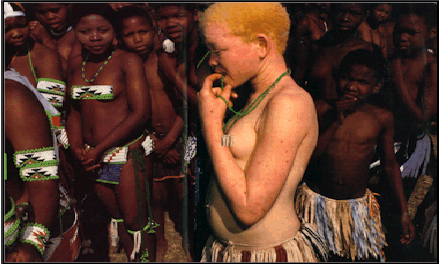
A twelve-year old albino boy was killed late yesterday by armed men in the central
Burundi district of Kiganda in what authorities suspect could be linked to witchcraft.
Albino hunters kill their victims and use their blood and body parts for potions. Witchdoctors tell their clients that the body parts will bring them luck in love, life and business.
“The twelve-year-old albino was killed by four men with guns and knives. They cut off his left hand and fled away with it,” Kiganda administrator Joseph Ntahuga, told Reuters today.
Ntahuga, a government official in the district 80 km from the capital Bujumbura, said the victim had two other albino siblings.
The murder brings to 14 the number of albinos killed in the tiny central African country since 2008.
The coffee producing nation of 8 million people has around 500 albinos, who lack pigment in their skin, eyes and hair.
Burundian authorities believe the killings are carried out local residents who work with witchdoctors in neighbouring Tanzania, where 53 albinos have been killed since 2007 for their body parts, which are sold for use in witchcraft. There are around 170,000 albinos living in Tanzania.
Kazungu Kassim, head of the national association of albinos, says albino killings continue in Burundi because severe punishment is not taken against the perpetrators.
“The solution is to sentence those responsible for albino killings to hang as it is done in Tanzania,” he said.
A man has been sentenced death by hanging for killing a five-year-old albino girl in Tanzania by hacking off her legs with a machete and then drinking her blood.
Pamela Anderson advert too racy for HK airport

Undated screen grab released by People for the Ethical Treatment of Animals (PETA) on December 29, 2010 shows actress Pamela Anderson in a security guard outfit playing a role in the animal rights advertisment ‘Cruelty Doesn’t Fly.
An animal rights commercial starring former Playboy centrefold Pamela Anderson, which is banned at some US airports, has been deemed too racy for Hong Kong, one of Asia’s busiest aviation hubs.
The advertisement, titled “Cruelty Doesn’t Fly”, features the scantily-clad former “Baywatch” star as an airport security guard who strips passengers of leather, fur and other skins.
A couple, seen nude from behind, also appears in the video commercial created by People for the Ethical Treatment of Animals (PETA).
“Given the groping that you see at security checkpoints and the nudity that you see in body scans we’re surprised that our lighthearted ad was deemed too risqué,” said Jason Baker, PETA Asia’s vice president.
The animal rights group said its ad was vetoed by JCDecaux, the advertising agency responsible for airing videos at Hong Kong’s airport.
In a statement, the city’s airport authority said the commercial was “considered inappropriate” because it might offend some visitors.
The ad – which also features comedian Steve-O, a star of the “Jackass” movie series, and German punk icon Nina Hagen – is already banned at airports in New York City and Boston, PETA said.
The animal rights group said it is still hoping to run the ad in other Asia-Pacific airports, including Tokyo, Seoul and Sydney.
North Korea again calls for end to confrontation with South

South Korean Army soldiers patrol along a seashore at sunset during a photo opportunity in Dangjin, southwest of Seoul.
North Korea called for end to confrontation and emphasised the need for dialogue with the South in a joint editorial published today by official newspapers, repeating the line from a year ago in the wake of clashes in 2010.
“Confrontation between north and south should be defused as early as possible,” said the joint editorial by three main official newspapers, carried by the KCNA news agency.
“Active efforts should be made to create an atmosphere of dialogue and cooperation between north and south by placing the common interests of the nation above anything else.”
But North Korea failed to make any detailed offer for talks and the rhetoric was largely along the line from a year ago, when the editorial said: “National reconciliation and cooperation should be promoted actively.”
Tensions between the rival Koreas have reached some of the highest levels since their 1950-53 Korean War in 2010, when the North shelled an island in the South killing four people.
South Korea and its allies also blamed the North for torpedoing one of the South’s navy ships in March, killing 46 sailors. Pyongyang denies the charge.
Car bomb hits church in Egypt, 21 killed

The aftermath of a bomb blast in Egypt's northern city of Alexandria
A car bombing outside a church killed 21 people in Egypt’s northern city of Alexandria as worshippers gathered to mark the New Year, security and medical sources said today.
The Interior Ministry earlier said 24 people were also wounded in the bombing, which prompted hundreds of Christians to take to the streets in protest. Some Christians and Muslims pelted each other with rocks, a witness said. Cars were torched.
Christians in Muslim-majority Egypt make up about 10 per cent of the nation’s 79 million people.
Egypt, due to hold a presidential election in September, has stepped up security around churches, restricting cars from parking directly outside them, after an al Qaeda-linked group in Iraq issued a threat against the church in Egypt in November.
The al Qaeda-linked Islamic State of Iraq, which claimed an attack on a church in Baghdad in November, threatened the Egyptian church over its treatment of women the group said the church was holding after they had converted to Islam.
“This is a scene from Baghdad,” a witness said by telephone.
Police used teargas to disperse the crowd on the streets. Ambulances were also at the scene where medical personnel gathered body parts that were scattered over the area.
“We sacrifice our souls and blood for the cross,” shouted protesting Christians near the Coptic Orthodox church where the blast struck, a witness said.
A statement from the Interior Ministry said the blast occurred just after midnight in front of the church after a service to mark the New Year. It said the blast damaged a mosque near the church and eight Muslims were among the 24 wounded.
Security and medical sources said 21 people were killed.
The ministry said an investigation had begun.
“The preliminary investigation indicates that a car was the reason behind the explosion. It was parked in front of the church and had been assumed to belong to one of the people who often come to the church,” said the ministry statement, which was read to Reuters by a ministry official.
Kameel Sadeeq, from the Coptic council in Alexandria, told Reuters: “People went in to church to pray to God but ended up as scattered limbs. This massacre has al Qaeda written all over, the same pattern Qaeda has adopted in other countries.”
In November, hundreds of Christians clashed with riot police, as well as some Muslims who joined in, during a protest over a decision to halt construction of a church. Officials said the church did not have a licence to be built.
Two Christians died as a result of those clashes and dozens were hurt, medical sources said. More than 150 were detained.
Analysts say the state must address grievances such as those over laws making it easier to build a mosque than a church if it wants to stem such sectarian violence.
Officials are swift to play down sectarian differences and are particularly sensitive to emphasise national harmony after a a parliamentary election in November that opposition groups said was rigged and before the presidential poll.
President Hosni Mubarak, 82 and in power since 1981, is expected to run again, if he is able. Gallbladder surgery last March rekindle questions about his health, although he has returned to a full schedule.
Pope to hold peace summit with religious heads

Pope Benedict leads his first mass of the New Year in St Peter’s Basilica at the Vatican today, January 1, 2011. Benedict will host a summit of world religious leaders in Assisi in October to discuss how they can promote world peace
Pope Benedict, worried over increasing inter-religious violence, will host a summit of world religious leaders in Assisi in October to discuss how they can better promote peace, he announced today.
Benedict told pilgrims and tourists in St Peter’s Square the aim of the meeting would be to “solemnly renew the commitment of believers of every religion to live their own religious faith in the service of the cause for peace”.
He made the announcement hours after a bomb killed at least 17 people in a church in Egypt in the latest attack on Christians in the Middle East and Africa.
The Assisi meeting will take place on the 25th anniversary of a similar encounter hosted by the late Pope John Paul in 1986 in the birthplace of St Francis.
That meeting was attended by Muslim and Jewish leaders and heads of many other religions, including the Dalai Lama, the spiritual leader of Tibetan Buddhists, and the Archbishop of Canterbury.
John Paul called on all nations and groups in conflict to silence their weapons during the meeting. Most groups adhered.
A main theme of the 1986 summit was the public repudiation of the concept of violence in the name of God.
“Humanity ... cannot be allowed to become accustomed to discrimination, injustices and religious intolerance, which today strike Christians in a particular way,” Pope Benedict said in his New Year’s Day homily to 10,000 people in St Peter’s Basilica on the day the Church marks its World Day of Peace.
“Once again, I make a pressing appeal (to Christians in troubled areas) not to give in to discouragement and resignation,” he said.
Hours earlier, in the northern Egyptian city of Alexandria, a bomb at a Coptic Christian church killed at least 17 people and wounded 43 as worshippers gathered to mark the New Year. The Egyptian Interior Ministry said it may have been the work of a foreign-backed suicide bomber.
The attack in Muslim-majority Egypt was the latest against Christians that has worried Church officials.
On Christmas Day, six people died in attacks on two Christian churches in the northeast of Nigeria, Africa’s most populous nation, and six people were injured by a bomb in a Roman Catholic Church on the island of Jolo in the Philippines.
In a message issued last month for the January 1 peace day, the pope said Christians were the most persecuted religious group in the world today and that it was unacceptable that in some places they had to risk their lives to practise their faith.
In November, 52 hostages and police officers were killed when security forces raided a Baghdad church to free more than 100 Iraqi Catholics captured by al Qaeda-linked gunmen.
The Vatican fears that continuing attacks, combined with severe restrictions on Christians in countries such as Saudi Arabia, are fuelling a Christian exodus from the region.
Subscribe to:
Posts (Atom)

