

Wednesday, November 9, 2011

Friday, October 21, 2011
Propofol infusion dominates Jackson doctor’s trial

A top medical expert offered damaging testimony against Michael Jackson’s former doctor yesterday, calling one defence theory a “crazy scenario” and offering a dramatic look at how the drug that killed the pop star could have been infused into his body.
The testimony of Dr Steven Shafer, an expert on the drug propofol that is seen as the chief cause of the singer’s death, left defendant Dr Conrad Murray looking exasperated as he sat in the courtroom.
It came as prosecutors were poised to wrap up their involuntary manslaughter case against Murray.
Murray has admitted that on June 25, 2009 — the day Jackson died — he injected the singer with propofol as a sleep aid but has pleaded not guilty to being responsible for his death.
In prior testimony, jurors have heard several doctors slam Murray for administering propofol by himself in a home when the powerful anaesthetic is normally used for surgery in a medical facility full of monitoring and emergency equipment.
Shafer demonstrated yesterday how Murray could have used a clumsy but deadly IV infusion of propofol to administer the drug into a vein in Jackson’s leg to help him sleep.
Jurors watched as the pure white propofol Jackson called his “milk” flowed down an IV tube and mixed with saline fluid, then emptied into a bottle that represented the singer’s body.
Shafer said it was essential for the anaesthetic to drip at a set rate and testified that Murray wrongly did not have a pump to control the flow. “He is responsible for every drop of propofol in that room,” Shafer told jurors.
Murray watched, wide-eyed and exasperated. After the demonstration, he slumped to one side of his chair with his hand at his mouth and a resigned look on his face.
Shafer is the final witness called by prosecutors. Murray’s defence attorneys are expected to cross-examine him today, then begin calling their own witnesses to the stand.
In his second full day on the stand, Shafer also undercut defence theories that Jackson could have given himself propofol and the anti-anxiety drug lorazepam and caused his own death.
Shafer said the 50-year-old “Thriller” singer would have had to inject himself several times with propofol, each time falling in and out of consciousness, to achieve a cumulative rise of the drug in his bloodstream.
“People don’t wake up ... hellbent to give themselves another dose,” Shafer said. “It’s a crazy scenario.”
He used charts to argue the most likely scenario to explain the level of propofol found in Jackson’s bloodstream at autopsy is that Murray had him on an intravenous drip of the drug when the singer went into cardiac arrest.
Before that moment, the propofol caused Jackson to stop breathing with Murray failing to keep watch over the singer, Shafer said. He added that had Murray paid attention, he could have saved Jackson.
“He could easily have just turned off the propofol infusion,” Shafer said. “... And there would have been no injury to Michael Jackson.”
Medical examiners determined Jackson died of an overdose of propofol, with the lorazepam playing a contributing role.
Murray’s defence attorneys, in addition to suggesting Jackson “self-administered” more propofol, have argued the singer could have swallowed more lorazepam than the four milligrams Murray said he infused into the singer.
But Shafer also criticised that theory. He said the amount of actual lorazepam found in Jackson’s stomach — as opposed to the harmless, metabolised form of the drug — was minuscule.
Murray faces a maximum four years in prison if convicted. — Reuters
Monday, February 28, 2011
Thailand to further probe killing of Reuters journalist

Thai investigators said today they were still trying to establish who killed Reuters cameraman Hiro Muramoto last year after reversing preliminary findings that a soldier probably fired the fatal bullet.
Muramoto (picture), a 43-year-old Japanese national, was killed by a high-velocity bullet wound to the chest while covering clashes between anti-government “red shirt” protesters and troops in Bangkok’s old quarter on April 10 last year.
Witness accounts in a preliminary state investigation said he was shot from the direction of troops, but authorities now say the type of bullet was inconsistent with those used by soldiers.
Thai investigators have concluded the fatal bullet was of 7.62 mm calibre and that soldiers were armed with M-16 rifles that fire 5.56 mm bullets, the director-general of the Department of Special Investigation (DSI), Tharit Pengdit, told a news conference.
“The bullet that shot Muramoto was 7.62 mm not M-16 that was used by the authorities,” Tharit said. “It could be an AK-47 or something similar ... but exactly who shot him I can’t answer at this point. We need more investigation.”
Television footage showed troops opening fire in the direction of hundreds of protesters, while soldiers came under attack from grenades. Mysterious black-clad gunmen were filmed moving among the demonstrators.
“Of course, the bullet came from the direction of the troops, but we don’t know who fired it because the troops were also surrounded by red-shirt protesters,” said Tharit of the bullet that killed Muramoto.
A preliminary version of the DSI report seen by Reuters in December quoted a witness as saying he saw “a flash from a gun barrel of a soldier”, then watched Muramoto fall after he was shot in the chest while filming the troops.
The DSI also acknowledged on November 16 a soldier may have fired the fatal shot, but said it was too early to conclude the case. The DSI’s report was sent to police for further investigation.
“The apparent contradiction between the preliminary investigation and these reports makes full transparency about the process and the findings imperative,” said Stephen J. Adler, Editor-in-Chief of Reuters News.
Tharit defended the DSI’s investigation. “The reason we submitted a finding earlier to police that Muramoto was likely shot by a soldier was because that was what the witness said. The witness also didn’t see where the bullet was exactly shot from.”
The latest DSI statement will likely rekindle debate over how exactly Muramoto was killed and the identity of mysterious black-clad gunmen filmed moving among the demonstrators or firing from above in sniper positions on the night the journalist died.
It also raises questions over the weapons used by the soldiers. Army spokesman Sansern Kaewkamnerd said troops deployed in Bangkok on April 10 were armed with US-made M-16 and Israeli-made Tavor rifles, but red shirt witnesses reported the presence of other types of weapons.
A law firm representing the red shirts and their figurehead, fugitive former Prime Minister Thaksin Shinawatra, issued a report on January 31 quoting from an unspecified number of unidentified officers in Thailand’s military who said the black-clad gunmen were members of the military.
The government says the shadowy gunmen were terrorists who were allied with the red shirts and responsible for most of the deaths during the clashes.
The Bangkok Post yesterday said “the army chief of staff paid the DSI head a visit to complain about an initial department finding” that blamed soldiers for the journalist’s death.
At least 91 people were killed in violence last April and May in Bangkok after the red shirt protesters occupied parts of the capital, and more than 1,800 were wounded. The military fought street battles with gunmen among the red shirts during the crisis, turning parts of central Bangkok into combat zones.
The military has repeatedly insisted that soldiers were not responsible for any of the deaths and injuries during the violence, a claim most independent observers consider implausible.
Monday, February 14, 2011
Berlusconi refuses to resign, dismisses protest

Protesters gather in Rome’s Piazza del Popolo to demonstrate against Italian Prime Minister Silvio Berlusconi on February 13, 2011
Prime Minister Silvio Berlusconi said today he had no intention of stepping down and dismissed a weekend demonstration by thousands of women across Italy over his involvement in a sex scandal.
Hundreds of thousands of women took part in rallies yesterday to defend their dignity and protest over the underage prostitution scandal that has rocked the 74 year-old prime minister’s centre-right government.
The billionaire media entrepreneur told his Canale 5 network the protests were the work of his political opponents and denied that he disrespects women.
“I saw the usual factional forces mobilised against me by a certain section of the left which uses any pretext to beat an adversary whom they can’t manage to beat at the polls,” he told a morning programme.
“All women who have had the opportunity to get to know me, know how much I respect them. I have always behaved and I always behave with great care and great respect, both in my companies and in my government.”
“I have always tried to act in such a way that every woman feels special,” he said.
Sunday’s protests included several leading figures from the opposition centre-left and many conservative middle-aged women, a group which has traditionally supported him.
Berlusconi said the government would not resign over the affair, potentially opening the way for new elections.
“There is a lot of confusion but I have very clear ideas. The interest of the country is to have a stable government which carries on with its programme with determination,” he said.
Milan prosecutors have requested that Berlusconi face trial over accusations that he paid for sex with a girl below the age of 18 — an offence in Italy — and that he improperly pressured police to release her from custody over theft allegations.
A decision on whether to accept the request is expected early this week.
Using material obtained from investigators’ wiretaps, newspapers have splashed lurid accounts of “bunga bunga” sex parties involving dozens of young women at Berlusconi’s private villa near Milan.
Berlusconi has never hidden his fondness for the company of young women but denies doing anything illegal and his lawyers have produced witness statements saying that the events at his villa were no more than convivial dinner parties.
“The Milan prosecutors’ office and the media in contrast has trampled on the dignity of my guests, exposing them to public scorn without any reason or regard for them and trampling on the truth,” Berlusconi said.
“It’s really a disgrace, a big disgrace.”
Saturday, February 12, 2011
Monday, September 27, 2010
Hearing begins in alleged plot to murder Afghans in widespread use of drugs in random killings of innocenet cilivians.
Cpl. Jeremy Morlock of Wasilla, Alaska, is among five Stryker soldiers charged with premeditated murder and conspiracy to commit premeditated murder. In interviews with Army investigators, he described a plot led by Staff Sgt. Calvin Gibbs to randomly kill civilians for sport while on patrol in Kandahar Province.
Prosecutors have also alleged that members of the platoon mutilated Afghan corpses and even collected fingers and other body parts, and that some posed for photos with Afghan corpses. Morlock talked about how they threw a grenade at a civilian to "wax him."
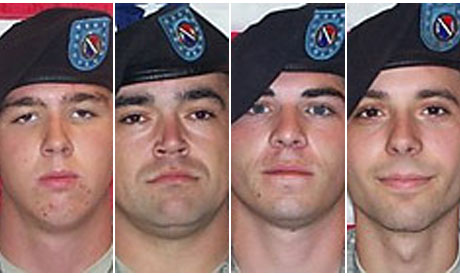
Morlock's attorneys are seeking to suppress the statements, saying they were made under the influence of muscle relaxants, sleeping pills and anti-nausea medicine prescribed for repeat concussions suffered during war. Morlock was being evacuated from Afghanistan for apparent traumatic brain injury when he was questioned in May.
They also blasted Army doctors and U.S. policy in a news conference, saying they didn't understand how a cornucopia of drugs could possibly render a brain-damaged soldier battle-ready. Morlock sustained his first concussion from a roadside bomb last November, and that's when the first drugs were prescribed, they said.
"This lad was all juiced up and it was by Army doctors," said attorney Geoffrey Nathan. "Why didn't they just recall him?"
Army Special Agent Anderson D. Wagner testified that Morlock was articulate during the interviews and that his account was corroborated by others in the unit. The hearing will determine whether the case proceeds to a court martial; Morlock and the others could face the death penalty if convicted.
"He made good eye contact. He was able to recount events that happened several months ago," Wagner said by audio feed from Kandahar.
Prosecutors listed 18 witnesses for Monday's hearing. Fourteen of them asserted their right to remain silent, including other defendants and 1st Lt. Roman G. Ligsay, who has been removed as leader of the platoon but is not charged.
Morlock's lawyers conceded they don't know specifically what drugs Morlock was taking at the time of the killings. Hashish smoking was rampant in the unit, and in some cases it may have been laced with opium, they said. The silence of other witnesses makes it hard for them to verify what drugs, prescribed or not, Morlock might have been on at the time of the killings, they said.
Portions of Morlock's interviews were aired by ABC News, and The Associated Press has reviewed statements he made under oath in which he claimed Gibbs — the highest ranking soldier accused — planned "scenarios" during which they could kill civilians. For example, Morlock said, if they came across someone in a village that had previously been flagged as having Taliban influence, they could toss a grenade at the civilian and claim they had been responding to a threat.
Gibbs also illicitly collected "drop weapons" that could be placed by the bodies to make them appear to be combatants, Morlock and others said.
"Gibbs had pure hatred for all Afghanis and constantly referred to them as savages," Morlock said in the statement reviewed by the AP. "Sometime after Christmas 2009, Gibbs gave me a (fragmentation) grenade and told me that if the situation presented itself that we should go ahead and run with the grenade scenario that he had briefed to us."
A few weeks later, in January, the first of the killings was carried out, followed by one in February and one in early May. In each, prosecutors say, Morlock and Gibbs enlisted one other soldier to be involved. Lawyers for those three say they either deny involvement or that their participation was unwitting.
Gibbs' attorney says all three killings were "appropriate engagements."
The case raised serious questions about the Army's handling of it. Spc. Adam Winfield, who is charged in the final killing, sent troubling Facebook messages home to his parents in Florida after the first killing. He wrote that he was being threatened to keep his mouth shut about it and that he didn't know what to do.
His father made nearly half a dozen calls to military officials that day, and he said he warned them about the ongoing plot and the threats against his son.
But no suspects were arrested until May, when a witness in a drug case in the unit alerted investigators to what he considered unjustified killings.
In cross-examination of Wagner and another investigator, Morlock's attorney, Michael Waddington, questioned the lack of forensic investigation into the killings. He pressed them on whether they really knew who killed which civilian, and why they had not exhumed the bodies or seized the weapons of the accused.
Wagner responded that investigators likely would have had trouble locating the bodies, and even if they did, it would be difficult to exhume them without upsetting local citizens.
"If it was on U.S. soil we would have done it, no question," he said. "It's not the United States. Everything we do has repercussions."
Judge critical of prosecutors in Anna Nicole trial
Earlier yesterday, both sides rested their cases after a nearly two-month trial that saw prosecutors bring numerous witnesses whose testimony defence attorneys largely sought to discredit. All three defendants have pleaded not guilty.

Defendants Howard K. Stern (left), Dr. Khristine Eroshevich (centre) and Dr. Sandeep Kapoor are shown in a combination photo during their arraignment at the Los Angeles County Criminal Courts building in Los Angeles, California, in this May 13, 2009 file photo.
Los Angeles Superior Court Judge Robert Perry characterised the case as a “kitchen-sink prosecution” in which numerous claims and evidence are put forth “against these defendants in the hope that something survives.”
The judge’s comments came as he considered dismissing or reducing some of the charges against the realty TV star’s one-time boyfriend and lawyer, Howard K. Stern, and two of her doctors, Khristine Eroshevich and Sandeep Kapoor.
Closing arguments are set to begin Thursday and jury deliberations may start early next week.
Prosecutors allege Stern, Eroshevich and Kapoor conspired to funnel prescription drugs to a known addict, Smith, who died in February 2007 in Florida from an accidental drug overdose at age 39. They are not charged with directly causing her death.
Still, Perry’s comments seem to underpin weeks of reports that prosecutors were having a difficult time proving their case. The judge said yesterday that many of the charges should have been misdemeanors, as opposed to the felonies that carry higher penalties.
“The prosecution had a dead celebrity and a lot of low-level misdemeanors” from which they tried to build a case for more serious crimes, Perry said.
But Deputy District Attorney Sean Carney defended prosecutors by saying their two-year investigation convinced them that felonies had been committed.
For much of the afternoon, lawyers discussed the meaning of words like “addict,” “addiction” and “pain” that the judge will use when instructing the jury on deliberations.
Prosecutors have argued that the defendants unlawfully prescribed or obtained controlled substances that fuelled Smith’s addiction over a three-year period when she was known to be a drug addict.
Defence attorneys have countered that Smith was not an addict, but was a sufferer of chronic pain since 2000. She also battled anxiety, depression and lack of sleep.
Wednesday, September 8, 2010
Wednesday, August 11, 2010
Farrow: Campbell said Taylor gave her diamond

Actress Mia Farrow told a war crimes court yesterday that she had heard supermodel Naomi Campbell say she had been given a “huge diamond” by Charles Taylor when he was Liberia’s president.
Campbell told the Special Court for Sierra Leone last week she had been given “dirty looking pebbles” after a 1997 dinner in South Africa, but did not know if they were diamonds from Taylor, on trial for war crimes and crimes against humanity.
In court yesterday, Farrow said the British model had joined a group of guests at breakfast after the charity dinner, hosted by South African president Nelson Mandela, and had started relating something that had happened overnight.
“She said in the night she had been awakened by men knocking at her door and they had been sent to her by Charles Taylor, and they had given her a huge diamond,” Farrow said, adding that Campbell had been “quite excited” about it.
Farrow told the court Campbell had said she would give the diamond to the Nelson Mandela Children’s Fund, adding that “it was a sort of an unforgettable moment”.
Taylor is charged with 11 counts of instigating murder, rape, mutilation, sexual slavery and conscription of child soldiers during wars in Liberia and Sierra Leone in which more than 250,000 people were killed. He denies all the charges.
Defence lawyer Courtenay Griffiths questioned Farrow’s recollection and also her impartiality, because of her active campaigning for justice for the victims of Africa’s wars.
UNCUT DIAMONDS
The former manager of Mandela’s Children Fund charity, Jeremy Ratcliffe, has said he received a number of uncut diamonds from Campbell, and handed them to South African police on Thursday after Campbell’s testimony.
Prosecutors are seeking to link the gems to Taylor to prove allegations, which he denies, that he received diamonds from rebels in Sierra Leone and used them to buy weapons.
Prosecutors showed Farrow Campbell’s testimony from last week and a U.S. media interview in which she denied saying the diamonds were from Taylor, or denied getting diamonds at all.
Farrow said Campbell’s versions of events were not consistent with hers. “Naomi Campbell said they came from Charles Taylor,” she added under questioning.
When the defence suggested that her memory of the events of 13 years ago was failing her, Farrow insisted: “I swear on this bible that that is what Naomi Campbell said at that breakfast.”
Under questioning from the judge, Farrow admitted she was unsure whether Campbell had said it was a “huge” or “large” diamond.
Defence lawyer Griffiths told the court: “Either Mia Farrow is lying for her own reasons, or she is mistaken.”
Later he told reporters: “Mia Farrow is here to follow her own agenda. She sees herself as the modern-day Mother Teresa for Africa.”
Farrow countered by telling the court: “If he (Taylor) is guilty of the crimes he is accused of, I am gratified that he is in this procedure, that he will be brought to justice.”
Saturday, August 1, 2009
Dr Conray Murray targeted for manslaughter investigation , maybe responsible fo MJ death

Michael Jackson "was looking for propofol and Dr. (Allan) Metzger turned him down and advised him how dangerous it was," Metzger's lawyer Harlan Braun tells PEOPLE. "Apparently, Jackson was shopping around for the drug or looking for someone to administer it to him."

A doctor of Michael Jackson says he prescribed drugs to the alias Omar Arnold.

Image show Dr Conray Murray .
Michael Jackson was recently warned against the dangers of the powerful anesthetic propofol by one of his former doctors, according to a lawyer for the physician.
Dr. Allan Metzger, an L.A.-based rheumatologist who also specializes in internal medicine, paid a visit to the singer's home in April, says Metzger's attorney Harlan Braun.
"Jackson was looking for propofol and Dr. Metzger turned him down and advised him how dangerous it was," Braun tells PEOPLE. "Apparently, Jackson was shopping around for the drug or looking for someone to administer it to him."
Jackson, who was a patient of Dr. Metzger's prior to 2003, also asked the doctor about general nutrition and the immunization of his children, Braun says.

Michael Jackson with Dr. Arnold Metzger.
Braun also confirms that Dr. Metzger was subpoenaed last month by the Los Angeles coroner in search of Jackson's medical records, making Metzger at least the fourth doctor to be have files searched in the apparent manslaughter investigation. Investigators reportedly believe Jackson was given propofol the night before his death by his personal physician, Dr. Conrad Murray.
"All my client did was turn down Michael's request for the drug and warn him of the dangers," Braun added. "Dr. Metzger did nothing wrong, and he's now a potential witness who can testify that Jackson was looking for the drug."
Dr. Metzger also previously treated another Jackson: Public records show Metzger was reprimanded in 2000 by the California Medical Board for using a fictitious name to write Janet Jackson a prescription.In the late 90s, Metzger wrote prescriptions for Janet Jackson using the name of her chef, Ricardo Macchi, he admits, saying the prescriptions were for diuretics.
Says Braun, who defended Metzger in that case: "Doctors have a duty to protect their client's privacy. Using false names for prescriptions is the only way to prevent a celebrity from being physically and emotionally harmed by the disclosure of their medical needs." Braun adds that he assumes Dr. Metzger wrote Michael Jackson prescriptions under a pseudonym when he treated the pop star prior to 2003.
"It's common practice even though it's illegal," Braun acknowledges, "which many doctors don't even know, because they think more like doctors than lawyers. But there's no protection against pharmacy workers selling private information to the tabloids."
The warrant also mentioned Cherilyn Lee, a nurse practitioner who treated Jackson earlier this year. Lee said Jackson begged her for propofol to help him get a good night's sleep. She said she refused, telling the pop star that if he took the medicine, he might never wake up.

Nutritionist Cherilyn Lee, who worked with Michael Jackson, is shown during an interview in Inglewood, Calif., in this June 29, 2009 file photo. Lee, a registered nurse, told the AP she repeatedly rejected his demands for Diprivan. But a frantic phone call she received from Jackson four days before his death made her fear that he somehow obtained Diprivan or another drug to induce sleep
News with Cherilyn Lee interview about her knowledge of Michael Jackson requesting drugs to sleep
Michael Jackson's personal doctor is the target of a manslaughter investigation into the singer's death. A search warrant filed Thursday allowed authorities to seek evidence of whether Dr. Conrad Murray committed a crime the singer's death.
----------------------------------------------------------------
Sunday, July 12, 2009
LaToya says Michael was really ‘murdered’ - Secret agreement ? between debbie&katherine jackson


-La Toya Yvonne Jackson (born May 29, 1956) is an American singer and the middle child of the Jackson family. Most notable for being featured on Playboy magazine and writing her memoirs on growing up in the Jackson family, she had a non-successful career as a singer during the 1980s and 1990s. She is the sister of the successful pop stars Michael and Janet Jackson. She released a comeback single called Just Wanna Dance in late 2004, which peaked at number 13 on the Billboard Hot Dance/Club Play chart.-
LaToya Jackson says in an explosive interview that she believes her brother Michael was murdered. The singer told the U.K.’s Daily Mail that a cabal of handlers exploited the King of Pop, plying him with drugs and pushing him to perform beyond the limits of his frail physical state.
“I believe Michael was murdered, I felt that from the start,” a tearful La Toya declared to the paper. “Not just one person was involved, rather it was a conspiracy of people.”
Speculating that Michael was railroaded into committing to a grueling schedule of 50 concerts in London, she added, “He was surrounded by a bad circle. Michael was a very meek, quiet, loving person. People took advantage of that.”
Chillingly, La Toya recalled, “Less than a month ago, I said I thought Michael was going to die before the London shows because he was surrounded by people who didn’t have his best interests at heart.” Eerily prescient words.
Custody Agreement?
Meanwhile, another British paper is reporting that Debbie Rowe, the biological mother of Michael Jackson’s elder two children, has reached a secret custody agreement with the late icon’s mother — to keep his father away from the kids.
According to the U.K.’s Daily Mirror, lawyers for the two women met secretly. The outcome: Debbie agreed to drop her bid for custody — and receive visitation rights — if Joe Jackson, who Michael claimed had abused him, was not part of their lives.
“The last thing she wanted was for those kids to be looked after by Joe and go through what Michael went through,” a source close to Debbie’s lawyer reportedly confided.
We can’t help but hope this turns out to be true. It sounds like it might be the best solution for the kids and everyone concerned.

