

Former South African President Nelson Mandela is recovering at home after spending two nights in hospital with a respiratory infection.
Saturday, January 29, 2011

Russian investigators uncover identity of Moscow bomber that kills 35 people
Russian investigators have said they now know the identity of the suicide bomber who claimed the lives of 35 people in an attack on Moscow's busiest airport last Monday.
Mubarak's dictatorship must end now
Days of rage in Egypt signify the end of days for Hosni Mubarak's repressive and bankrupt regime. For 30 years, the president has held his country down through fear, secret police, emergency laws, American cash subsidies and a lamentable absence of ...
Bindi: Women will turn against ‘sultan’ Berlusconi

One of Italy’s most senior woman politicians has condemned Prime Minister Silvio Berlusconi as a “sultan” who degrades women, and predicted many of those who voted for him will abandon him in the next election.
Rosy Bindi, president of the opposition Democratic Party and deputy speaker of the lower house of parliament, said in an interview that sex scandals were likely to cost Berlusconi power.
“Italian women are paying the highest price for this scandal, with an image being spread of women whose value is reduced to their bodies and who become tradeable goods at the disposal of the sultan, the emperor,” she told Reuters.
“Berlusconi has based an important part of his electoral success on women . . . but undoubtedly his approval ratings are now falling . . . women will represent a key element in putting an end to Berlusconi’s honeymoon in our country,” she said in her office in the lower house yesterday evening.
Italy’s next elections are not scheduled until 2013 but most commentators say either Berlusconi’s sex scandals or the fracturing of the centre right will lead to the collapse of his government and early national polls, perhaps this year.
Milan prosecutors have alleged that Berlusconi paid for sex with prostitutes who attended parties at his villa, including a teenaged nightclub dancer Karima El Mahroug, who goes by the stage name of “Ruby the Heart-Stealer”.
The billionaire media mogul denies any wrongdoing and says he has never paid for sex. He says politically motivated leftist magistrates are bent on destroying him and he has refused to face questioning.
Berlusconi has survived previous scandals about his private life. Middle-aged and elderly women have been key sources of electoral support for the prime minister.
But Bindi, who has called for Berlusconi to resign, said the most recent scandal would likely be seen as a step too far.
“In the last weeks there has been a jump to a new level: before it was our head of government who was ridiculed, but now we are all at risk of being ridiculed,” she said.
Newspapers have run transcripts of phone taps by magistrates that paint a picture of wild parties attended by Berlusconi, other older men and young starlets and models who received money and favours such as free rent.
Berlusconi has frequently joked about Bindi, once calling the bespectacled, grey-haired 59-year-old “more beautiful than intelligent”.
That stirred a backlash from thousands of Italian women, and her quick response — “I’m not a woman at your disposal” — became a rallying cry printed on T-shirts and placards.
Bindi said then there was a “new feminism” taking root in Italy, where scantily clad women are a common sight on TV, especially on channels owned by Berlusconi.
“When Berlusconi starts to offend me or others, I rely on my inner strength, and in that case I told him I’m not at his disposal like a woman he can buy,” she told Reuters.
Facebook denies it’s to launch branded phones with HTC

Of the estimated more than 350 million people who log on to Facebook each month, the social network provider says 250 million use mobile devices.
Facebook has no plans to launch Facebook-branded phones with Taiwanese smartphone maker HTC, it said today, following reports that it planned to launch an official tie-up next month.
“This is really just another example of a manufacturer who has taken our public APIs (application programming interfaces) and integrated them into their device in an interesting way,” said Dan Rose, head of business development at Facebook.
London business newspaper City A.M. had reported that HTC would unveil two new Facebook-branded mobile phones at the Mobile World Congress in Barcelona next month, in a story that was widely picked up in other media.
“The rumours around there being something more to this HTC device are overblown,” Rose told journalists at a company event in London. Asked whether the device would be Facebook-branded, he answered: “No.”
Mobile is an increasingly important driver of traffic to Facebook, which says 250 million users a month access the social network on mobile devices.
HTC was the manufacturer of the first Google-branded phone, the Nexus One.
UK police arrest WikiLeaks backers for Web attacks

British police arrested five young men yesterday as they and US authorities conducted searches as part of a probe into Internet activists who carried out cyber attacks against groups they viewed as enemies of the WikiLeaks website.
“The arrests were related to recent ‘distributed denial of service’ (DDoS) attacks by an online group calling themselves Anonymous,” London police said in a statement.
In the United States, the Federal Bureau of Investigation said that agents executed more than 40 search warrants as part of its investigation and that the attacks were facilitated by software the group made available for free on the Internet.
“The FBI is working closely with its international law enforcement partners and others to mitigate these threats,” the agency said in a statement, adding that there were other, unspecified investigative and enforcement actions in the Netherlands, Germany and France.
WikiLeaks, which was founded by Australian-born Julian Assange, has disclosed classified US diplomatic dispatches which included candid and embarrassing assessments of world leaders as well as classified documents related to the wars in Iraq and Afghanistan.
In addition to the probe into the cyber attacks, US authorities have been investigating the leak of the documents themselves and their prime suspect has been a former US Army intelligence analyst, Bradley Manning.
Internet activists last month carried out a series of online assaults against institutions they viewed as enemies of WikiLeaks, temporarily bringing down the websites of credit-card giants Visa and MasterCard, Amazon.com and of the Swedish government.
Sweden wants Assange extradited from Britain so he can answer questions over sexual assault allegations.
Officers from a specialist London police unit dealing with online crime detained the five males, aged from 15 to 26, in raids at homes in central and southern England.
Dutch police last month arrested two teenagers suspected of involvement in the online campaign. They face trial later this year.
A DDoS attack consists of swamping the resources of a computer such as a server to make it unavailable to users.
The maximum penalty in Britain for offences of computer misuse is 10 years imprisonment and a fine of £5,000 (RM24,272).
In the United States, such a cyber attack carries a maximum punishment of 10 years in prison and significant fines.
Egypt unrest rages; web shut ahead of big protest

Egyptian demonstrators fought security forces into the early hours of today in the city of Suez, and the Internet was blocked ahead of the biggest protests yet planned against President Hosni Mubarak’s 30-year rule.
Emboldened by this month’s revolt that toppled the authoritarian leader of Tunisia, Egyptians have staged mass protests since Tuesday. The biggest demonstrations yet are planned for this afternoon after weekly prayers.
“This is a revolution,” one 16-year-old protester said in Suez late yesterday. “Every day we’re coming back here.”
Nobel Peace Prize winner Mohamed ElBaradei, who returned to Egypt from Vienna yesterday, has called for Mubarak to resign and said he would join the protests today.
Internet access was shut down across the country shortly after midnight. Mobile phone text messaging services also appeared to be partially disabled, working only sporadically.
Activists have relied on the Internet, especially social media services such as Twitter and Facebook, to organise.
US State Department spokesman P.J. Crowley said in a “tweet” message: “We are concerned that communications services, including the Internet, social media, and even this tweet are being blocked in Egypt.”
A page on Facebook listed more than 30 mosques and churches where protesters were expected gather.
“Egypt’s Muslims and Christians will go out to fight against corruption, unemployment and oppression and absence of freedom,” it said.
In Suez, which has been ground zero for some of the most violent demonstrations, police fired tear gas at protesters, who hurled stones and petrol bombs into the early hours of today. Fires burned in the street, filling the air with smoke.
The city fire station was ablaze. Waves of protesters charged towards a police station deep into the night. Demonstrators dragged away their wounded comrades into alleys.
Security forces shot dead a protester in the north of the Sinai region yesterday, bringing the death toll to five.
Video images obtained by Reuters showed the man among a small group of protesters some distance from the security forces when he suddenly collapsed with a gunshot wound and was dragged away by other demonstrators. The video circulated widely on the Internet, galvanising anger.
Members of the Muslim Brotherhood, including at least eight senior officials of the opposition group and its main spokesmen, were rounded up overnight. A security source said authorities had ordered a crackdown on the group.
“Wiped from Internet map”
US-based Internet monitoring firm Renesys said the total shutdown of the Internet that it recorded early today was “unprecedented in Internet history”, going far beyond measures taken during Tunisia’s protests or a 2009 uprising in Iran.
“Renesys observed the virtually simultaneous withdrawal of all routes to Egyptian networks in the Internet’s global routing table,” it said. “The Egyptian government’s actions tonight have essentially wiped their country from the global map.”
The United States is Egypt’s close ally and major donor, and has tread carefully over unrest in a country that it considers a bulwark of Middle East stability.
In his first comments on the unrest, President Barack Obama avoided signs of abandoning Mubarak but made clear he sympathised with demonstrators.
“. . . I’ve always said to him that making sure that they are moving forward on reform — political reform, economic reform — is absolutely critical to the long-term well-being of Egypt,” Obama said in comments broadcast on the YouTube website.
“You can see these pent-up frustrations that are being displayed on the streets.”
ElBaradei and other opposition figures say the government exploits the Islamist opposition to justify authoritarianism.
The Muslim Brotherhood has kept a low profile during the protests, although its supporters were expected to join demonstrations today. The government has accused it of planning to exploit the youth protests for its “hidden agendas”, while the Brotherhood says it is being used as a scapegoat.
Frustrations
As in many other countries across the Middle East, Egyptians are frustrated over surging prices, unemployment and an authoritarian government that tolerates little dissent.
Many of them are young. Two-thirds of Egypt’s 80 million people are below the age of 30, and many of them have no jobs. About 40 per cent of Egyptians live on less than a US$2 (RM6) a day.
The government has urged Egyptians to act with restraint today. Safwat Sherif, secretary-general of the ruling National Democratic Party, told reporters:
“We hope that tomorrow’s Friday prayers and its rituals happen in a quiet way that upholds the value of such rituals . . . and that no one jeopardises the safety of citizens or subjects them to something they do not want.”
ElBaradei, 68, a former head of the UN nuclear watchdog who has campaigned for change in his native country since last year, told reporters at Cairo’s airport he would take part in today’s protests. He added: “I wish we did not have to go out on the streets to press the regime to act.”
Taliban claims deputy governor's assassination
The Taliban has claimed responsibility for the assassination of the deputy governor of Afghanistan's Kandahar province. As Abdul Latif Ashna was leaving home to head to work, a suicide bomber riding a motorbike ...
American political activist who idolised Gandhi dies after setting fire to himself in India
American political activist Jeff Knaebel has committed suicide by setting himself on fire in northern India.
The 71-year-old was found by villagers on Wednesday at an ancient Buddhist chapel in Virat Nagar, a town 90 miles north of Jaipur, police said.
Knaebel, who idolised Gandhi, left a suicide note blaming cruel incidents in both the United States and India.
 Suicide: The remains of political activist Jeff Knaebel have been found at an ancient Buddhist chapel in northern India
He did not give any further explanation for his death, but did leave behind around 48,000 rupees ($1,000).
He also left a shoulder bag containing glasses, books on Gandhi and a note asking that the money was given to poor widows and farmers, according to police.
He had been spotted in the town three days earlier and was seen by villagers wearing an Indian-style long cotton shirt, woolen sweater and a scarf.
It is understood he may have timed his death to coincide with India's Republic Day, which celebrates the signing of the country's constitution.
He had previously been denied asylum in the country and had had an application for citizenship denied.
Knaebel was travelling across the country to avoid being arrested for not having any documentation.
'Citizenship denial and harassment by police ... made him a very desperate person, but he continued to believe in the principles of Gandhi and often said he would never return to the U.S. and would die in India,' his friend and fellow engineer V.K. Desai told the Associated Press.
Desai remembered Knaebel as an intelligent and honorable man who delighted in nature, gave his money to the poor, and worried increasingly about inviting police action against his friends if he stayed with them on his travels.
Knaebel was identified from a passport issued in July by the World Government of World Citizens, an organisation based in Washington, D.C..
His body now lies in a hospital morgue, police said. The U.S. Embassy declined to comment for privacy reasons.
The 71-year-old was found by villagers on Wednesday at an ancient Buddhist chapel in Virat Nagar, a town 90 miles north of Jaipur, police said.
Knaebel, who idolised Gandhi, left a suicide note blaming cruel incidents in both the United States and India.

He did not give any further explanation for his death, but did leave behind around 48,000 rupees ($1,000).
He also left a shoulder bag containing glasses, books on Gandhi and a note asking that the money was given to poor widows and farmers, according to police.
He had been spotted in the town three days earlier and was seen by villagers wearing an Indian-style long cotton shirt, woolen sweater and a scarf.
It is understood he may have timed his death to coincide with India's Republic Day, which celebrates the signing of the country's constitution.
He had previously been denied asylum in the country and had had an application for citizenship denied.
Knaebel was travelling across the country to avoid being arrested for not having any documentation.
'Citizenship denial and harassment by police ... made him a very desperate person, but he continued to believe in the principles of Gandhi and often said he would never return to the U.S. and would die in India,' his friend and fellow engineer V.K. Desai told the Associated Press.
Desai remembered Knaebel as an intelligent and honorable man who delighted in nature, gave his money to the poor, and worried increasingly about inviting police action against his friends if he stayed with them on his travels.
Knaebel was identified from a passport issued in July by the World Government of World Citizens, an organisation based in Washington, D.C..
His body now lies in a hospital morgue, police said. The U.S. Embassy declined to comment for privacy reasons.
Nelson Mandela leaves hospital after treatment

Nelson Mandela leaving for home in a military ambulance, where he will continue to receive treatment.
Former South African president Nelson Mandela left hospital today after treatment for an acute respiratory infection, officials said.
Mandela, 92, was admitted on Wednesday, prompting fears for the anti-apartheid icon who led South Africa as its first black president and is revered at home and abroad as a symbol of reconciliation and hope.
“Madiba is well,” Deputy President Kgalema Motlanthe said, using Mandela’s clan name.
“He is fine. He’s O.K. He is in good spirits. He was joking with us,” said Motlanthe.
South Africa’s surgeon general told the same news conference Mandela was stable and was discharged after treatment for an acute respiratory infection.
“There is no need to panic or to try to see more in what we are saying. For a 92-year-old, he surprises us on a daily basis on his power of recovery,” Vejayanand Ramlakan said.
Mandela arrived at his home in Johannesburg’s leafy Houghton suburb in a military ambulance, escorted by several police vehicles, Reuters witnesses said.
Ramlakan said Mandela would continue to get medical treatment at home, giving no further details of his illness. A source close to Mandela told Reuters yesterday that he was recovering from a collapsed lung.
TB in jail
Mandela was diagnosed with tuberculosis in the 1980s while he was jailed, and later had an operation to repair damage to his eyes. In 2001 he had treatment for prostate cancer. He was released from prison in 1990 after 27 years’ imprisonment.
President Jacob Zuma and the ruling African National Congress appealed for calm after the hospitalisation set off speculation in local media about Mandela’s health and brought family members and dignitaries rushing to the hospital.
Motlanthe acknowledged that the government and other parties involved could have handled Mandela’s hospitalisation better.
Nearly 24 hours passed from when the Nelson Mandela Foundation said the former president was in hospital for routine tests to the presidency issuing a statement on his health.
Mandela has not been seen in public since the football World Cup final in July last year, when he made a brief appearance waving from a golf buggy.
In Washington, the White House said President Barack Obama’s thoughts were with Mandela.
Mandela retired from public life in June 2004 before his 86th birthday, telling his compatriots: “Don’t call me, I’ll call you.”
Since then he has rarely appeared in public and when he did, he appeared increasingly frail. In addition to the World Cup, Mandela appeared at a couple of ANC rallies before general elections in 2009.
Charlie Sheen enters Rehabs for drug and alcohol abuse with pornstar in orgies.
For fans of Two and a Half Men, the news that Charlie Sheen would voluntarily enter a rehabilitation center was no doubt bittersweet: The 45-year-old actor could get the help that he needs even though his ...
WikiLeaks founder says enjoys making banks squirm

WikiLeaks founder Julian Assange says he enjoys making banks squirm thinking they might be the next targets of his website which has published US diplomatic and military secrets.
“I think it’s great. We have all these banks squirming, thinking maybe it’s them,” Assange told the CBS television programme “60 Minutes” in an interview.
CBS released a partial transcript yesterday ahead of Sunday’s broadcast of the full segment.
Bank of America Corp shares fell more than 3 per cent on November 30 on investor fears that the largest US bank by assets would be the subject of a document release.
Interviewer Steve Kroft asked Assange whether he had acquired a five-gigabyte hard drive belonging to one of the bank’s executives, as Assange had previously asserted.
“I won’t make any comment in relation to that upcoming publication,” said Assange, who is under a form of modified house arrest in England, awaiting an extradition hearing to Sweden for questioning over alleged sex offences that he denies.
Assange had told Forbes magazine that WikiLeaks planned a “megaleak” by releasing tens of thousands of internal documents from a major US bank in early 2011 that he expected would lead to investigations of the bank.
In an October 2009 interview, Assange told Computerworld that WikiLeaks had obtained five gigabytes of data from a Bank of America executive’s hard drive.
The Forbes interview came just after WikiLeaks released 250,000 US government diplomatic cables. Previously, WikiLeaks had made public nearly 500,000 classified US files on the wars in Iraq and Afghanistan.
Major headlines were generated by some of the cables, which revealed that Saudi leaders had urged US military action against Iran and detailed contacts between US diplomats and political dissidents and opposition leaders in some countries.
Assange told “60 Minutes” he fully expected US retaliation but that the American government was incapable of taking his website down.
“The US does not have the technology to take the site down. ... Just the way our technology is constructed, the way the Internet is constructed,” Assange said.
“We’ve had attacks on particular domain names. Little pieces of infrastructure knocked out. But we now have some 2,000 fully independent in every way websites, where we’re publishing around the world. It is — I mean, it’s not possible to do.”
WikiLeaks says it is a nonprofit organisation funded by human rights campaigners, journalists and the general public. Launched in 2006, it promotes the leaking of information to fight government and corporate corruption.
Egypt wakes to devastation, Mubarak refuses to quit

Mubarak addresses the nation on Egyptian state TV in Cairo yesterday, January 28, 2011 where he called for dialogue and said he would name a new government today.
President Hosni Mubarak clung to power in Egypt today after days of popular protests against his 30-year-old rule in which at least 24 people were killed and more than 1,000 wounded.
Mubarak refused to bow to protesters’ demands that he quit and ordered troops and tanks into cities overnight in an attempt to quell demonstrations that left a trail wreckage across Cairo.
The ruling party’s headquarters were still burning this morning and demonstrators were still out in the streets in the early hours in defiance of a curfew. Daybreak revealed ransacked shops and burnt-out buildings.
Mubarak promised to appoint a new Cabinet today and called for dialogue to avert chaos.
Medical sources said at least 24 people had been killed and more than 1,000 wounded in yesterday’s clashes in Cairo, Suez and Alexandria.
“It is not by setting fire and by attacking private and public property that we achieve the aspirations of Egypt and its sons, but they will be achieved through dialogue, awareness and effort,” the president said in a midnight TV address, his first public appearance since the protests began four days ago.
The unprecedented unrest has sent shock waves through the Middle East, where other autocratic rulers may face similar challenges, and unsettled global financial markets yesterday.
US President Barack Obama said he spoke to Mubarak and urged “concrete steps that advance the rights of the Egyptian people”.
The protests bore many hallmarks of the unrest that toppled the leader of Tunisia two weeks ago, although the arrival of army troops to back up the police showed that Mubarak still has support of the military, the country’s most powerful force.
Protesters mocked his decision to sack his Cabinet as an empty gesture.
“It was never about the government, by God. It is you (Mubarak) who has to go! What you have done to the people is enough!” said one.
“The people want the president to fall,” dozens of youths chanted to a Reuters TV camera in the early morning in Tahrir square in central Cairo.
Some youths held up empty shotgun cartridges, teargas canisters and unused live rounds.
Tanks stood on roads leading into the square. One army armoured personnel carrier was gutted by fire. The square was strewn with rubble, burned tyres and charred wood that had been used as barricades overnight.
The army’s arrival had initially been welcomed by crowds, frustrated by heavy-handed police. But the damage to army vehicles showed that this swiftly wore off and protesters overnight accused the army of taking the same police line.
“What happened was a betrayal of the people... We were celebrating the army’s presence when they got to Tahrir, we let them through to take over from the dirty riot police and then we got fired at again,” Marzouq, a protester, in his 20s, said.
Cars began returning to the streets and there were other signs of normal life resuming but the wreckage was widespread.
In central Cairo, a petrol station was smashed and the burnt-out shells of three cars lay on the street nearby. Elsewhere, police trucks and pick-ups still smouldered in the acrid air, filled with the smell of smoke and teargas.
The ruling party headquarters in Cairo, set ablaze yesterday, was still burning.
In Cairo’s Mohandiseen district, jewellery shops were ransacked and emptied. A Reuters team saw a gang of looters storm into a bank and carry out the safe overnight.
More than half of the dead in yesterday’s clashes were reported in Suez, the eastern city which was a focus of the most violent protests over the past four days.
Some Egyptians expressed fear that more unrest would leave their country in ruins, and hoped Mubarak would go quickly.
“We don’t want this regime to leave this country in a state of destruction. We want it to go away. We need to give them a safe haven to leave this nation. Leave us, enough,” Salah Abdel Maqsoud, a senior official in the Journalists Union close to the opposition Muslim Brotherhood, told Al Jazeera television.
Mubarak, 82, has been a close ally of Washington and beneficiary of US aid for decades, justifying his autocratic rule in part by citing a danger of Islamist militancy.
The Muslim Brotherhood opposition, however, appears to have played a backseat role in the unrest.
His government has largely shut Egypt off from the Internet, which protesters used to organise. The mobile phone network in Cairo was still out of action. Obama called for an end to interference with communications networks.
“I want to be very clear in calling upon the Egyptian authorities to refrain from any violence against peaceful protesters,” Obama said.
Anthony Skinner, associate director of political risk consultancy Maplecroft, said Mubarak’s conduct was reminiscent of that of Tunisia’s ousted leader Zine al-Abedine Ben Ali, who also fired his Cabinet hours before he was forced to flee.
“Mubarak is showing he is still there for now and he is trying to deflect some of the force of the process away from himself by sacking the Cabinet. We will have to see how people react but I don’t think it will be enough at all.”
Markets were hit by the uncertainty. US stocks suffered their biggest one-day loss in nearly six months, crude oil prices surged and the dollar and US Treasury debt gained as investors looked to safe havens.
Egyptian president Mubarak names his deputy and new PM - widespread violent protests.
Protests continue as Egyptian president appoints former spy chief as his vice-president for the first time. Egyptian President Hosni Mubarak has appointed the country's head of intelligence to the post of vice-president, in a move said to be a reaction ...
New clashes erupt as Egyptians spurn Mubarak speech

Thousands of anti-government protesters clashed with police in the northern Egyptian city of Alexandria today after President Hosni Mubarak spurned demands that he end his 30-year authoritarian rule.
A Reuters witness said police used teargas and live ammunition against demonstrators in Alexandria. Protesters also gathered on a main square in the capital Cairo in defiance of military orders for them to disperse.
The fresh unrest broke out as Mubarak clung to power, replacing his Cabinet in an effort to appease angry Egyptians, complaining about poverty, corruption and unemployment.
The president ordered troops and tanks into Cairo and other cities overnight and imposed a curfew in an attempt to quell the protests that have shaken the Arab world’s most populous nation, a key US ally, to the core.
Despite dozens of deaths in clashes yesterday, Egyptians said they would press on with protests until Mubarak quits.
“We are not demanding a change of Cabinet, we want them all to leave, Mubarak before anyone else,” said Saad Mohammed, a 45-year-old welder who was among about 2,000 people gathered in Cairo’s central Tahrir Square.
The unrest, which follows the overthrow of Tunisian strongman Zine al-Abidine Ben Ali two weeks ago in a popular uprising, has sent shock waves through the Middle East, where other autocratic rulers may face similar challenges.
The capital was strewn with wreckage from a day of protests yesterday when protesters fought running battles with police firing rubber bullets, teargas and wielding batons — an unprecedented turn of events in the tightly-controlled country.
Government buildings, including the ruling party headquarters, still blazed this morning after being set alight by demonstrators who targeted symbols of Mubarak’s rule.
According to a Reuters tally, at least 74 people have been killed in the unrest. There was no official figure. Medical sources said at least 1,030 people were injured in Cairo, but with more protests starting throughout the country, the number was bound to rise.
As well as Cairo and Alexandria, clashes have also occurred in Suez, site of the strategically important canal.
The demonstrators, many of them young urban poor and students, complain of repression, corruption, and economic despair under Mubarak, who has held power since the 1981 assassination of President Anwar Sadat by Islamist soldiers.
Mubarak, whose government still rules with emergency laws, promised to address Egyptians’ grievances in a television address last night. He sacked the Cabinet but made clear he intended to stay in power and he condemned the violence.
The Cabinet was meeting today to formalise the move.
So far, the protest movement seems to have no clear leader or organisation even if Mubarak did wish to open a dialogue.
Prominent activist Mohamed ElBaradei, a Nobel Peace Laureate for his work with the UN nuclear agency, returned to Egypt from Europe to join the protests. But many Egyptians feel he has not spent enough time in the country.
In an interview with France 24 television, El Baradei said Mubarak should step down and begin a transition of power.
“There is a consensus in Egypt in every part of society that this is a regime that is a dictatorship, that has failed to deliver on economic, social, and political fronts,” he said. “We need a new beginning.”
The Muslim Brotherhood, an Islamist opposition group, has also stayed in the background, although several of its senior officials have been rounded up. The government has accused it of planning to exploit the protests.
The deployment of army troops to back up the police showed that Mubarak still has the support of the military, the country’s most powerful force. But any change of sentiment among the generals could seal his fate.
The army told Egyptians today not to gather in groups and to observe the curfew, which was extended by two hours to begin at 4pm (1400 GMT).
Tanks were parked on roads leading into Tahrir Square, which was strewn with rubble, burned tyres and charred wood that had been used as barricades overnight.
The number of protesters was fewer than in previous days but they were nonetheless defiant.
“This is unacceptable, Mubarak must step down. Public unrest will not stop until this is achieved,” said Mohammed Essawy, a 26-year-old graduate student.
Protesters mocked Mubarak’s sacking of his Cabinet as an empty gesture.
Mahmoud Mohammed Imam, a 26-year-old taxi-driver, said: “All he said was empty promises and lies. He appointed a new government of thieves, one thief goes and one thief comes to loot the country.”
“This is the revolution of the people who are hungry, this is the revolution of the people who have no money against those with a lot of money.”
The final straw appeared to be the prospect of elections due to be held in September. Until now few had doubted that Mubarak would remain in control or bring in a successor in the shape of his 47-year-old son Gamal.
It also poses a dilemma for the United States. Mubarak, 82, has been a close ally of Washington and beneficiary of US aid for decades, justifying his autocratic rule in part by citing a danger of Islamist militancy.
Egypt plays an important role in Middle East peacemaking and was the first Arab nation to sign a peace treaty with Israel.
US President Barack Obama said he had spoken to Mubarak shortly after his speech yesterday and urged him to make good on his promises of reform.
“I want to be very clear in calling upon the Egyptian authorities to refrain from any violence against peaceful protesters,” Obama said. US officials made clear that US$1.5 billion (RM4.6 billion) in aid was at stake.
Anthony Skinner of political risk consultancy Maplecroft said Mubarak’s conduct was reminiscent of that of Tunisia’s Ben Ali, who fired his Cabinet hours before he was forced to flee.
“Mubarak is showing he is still there for now and he is trying to deflect some of the force of the process away from himself by sacking the Cabinet. We will have to see how people react but I don’t think it will be enough at all.”
Saturday, January 1, 2011
Australia floods cover area size of France/Germany


Flood waters rose across Australia’s northeast today, covering an area bigger than France and Germany combined, inundating 22 towns and stranding 200,000 people, and closing one of the country’s major sugar export ports.
Flooding has already shut major coal mines in Queensland state and its biggest coal export port, forcing a long list of miners such as Anglo American and Rio Tinto to slow or halt operations.
The worst flooding in about 50 years has been caused by a La Nina weather pattern that has resulted in torrential rain over the past two weeks across northeast Australia.
“This disaster is a long way from over,” Queensland state premier Anna Bligh told reporters today.
“We now have 22 towns or cities that are either substantially flooded or isolated. That represents some 200,000 people spanning an area that’s bigger than the size of France and Germany combined.”
Prime Minister Julia Gillard toured the flood-hit sugar city of Bundaberg, which closed its port today after flood debris was washed downstream into shipping channels and damaged navigation beacons.
“This is a natural disaster across Queensland,” said Gillard in announcing a A$1 million (RM3.1 million) government contribution to a flood aid appeal that now totals A$6 million.
Shipments of sugar from Australia, one the world’s leading exporters of the sweetener, have been disrupted because of the closure of Bundaberg’s port. The port normally ships about 400,000 tonnes of raw sugar a year, with three 30,000-tonne vessels due to arrive in the next few days.
“If the port is closed for only a few days it won’t be a big issue but any extended delay would cause some concern,” said Brian Mahoney, an executive with Marybrough Sugar Factory Ltd, which ships through Bundaberg.
The inland sea that now stretches across Queensland is dotted with the roofs of flooded homes, islands of dry ground crowded with stranded livestock, and small boats ferrying people and emergency supplies.
Bundaberg resident Sandy Kiddle hugged Gillard as she told of the heartbreak of seeing her house flooded.
“It was just a sea of water and I thought the beach would never come to our house,” Kiddle told Gillard from the evacuation centre she now calls home.
Australia has recorded its wettest spring on record, said the nation’s weather bureau, causing six major river systems in Queensland state to flood. Several rivers in New South Wales state have also caused flood damaging the nation’s wheat crop.
Possibly as much as half the Australian wheat crop or about 10 million tonnes has been downgraded to less than milling quality because of rain damage, tightening global supplies and contributing to prices for the grain rising about 45 per cent this year, the biggest surge since 2007.
The floods have also pushed coking coal and thermal prices sharply higher, and tight markets are keeping a close eye on further disruptions. Queensland’s ports have an annual coal export capacity of 225 million tonnes.
Australia is the world’s biggest exporter of coking coal used to make steel, and accounts for about two-thirds of global trade. It is also the second-biggest exporter of thermal coal used for power generation.
Emergency authorities in Queensland said the flooding was not expected to reach a peak in some areas until Sunday, and would not recede for at least a week.
Authorities are warning of rising health risks from floodwaters in Queensland, along with the danger of crocodiles and snakes in flooded homes.
Female Chinese students resort to eating roundworm eggs to ensure they look thin for job interviews

Female students in China have been eating roundworm eggs to lose weight for job interviews - because employment is so hard to come by.
They hatch in the stomach, allowing those who take them to shed pounds without exercising or dieting in the Xiamen, China.
But swallowing the worms is extremely dangerous - and definitely not to be recommended for those wanting to shed the pounds in the New Year.
With jobs shortages across the country, women in China are under pressure to appear thin if they are to have any chance of landing a role.
Employment stands at 22 per cent - and the size of the labour pool has grown by 112 million people over the last decade to more than one billion people.
Other students are staring at pictures for hours on end to suppress their appetite so they can shed excess weight.
A student called Xiaomei said that women are using a 'special soap' that helps them with their diets. Some are having up to 10 showers each day.
The treatments have no scientific basis and are likely to damage health.
In the 1990s Chinese women would take special teas and pills to lose weight. Acupuncture also emerged as a popular choice.
But many students struggle to find work as the world's most populous nation faces big unemployment problems with only 780 million labourers in jobs.
However, the work problem is largely confined to rural areas. Jobs in cities are being created quickly as China undergoes a rapid urbanisation.
'China is facing huge employment pressures at present and for the foreseeable future,' Yi Chengji, spokesman for the Ministry of Human Resources and Social Security said.
'As China's urbanisation quickens, employment pressures from the many surplus rural labourers are getting bigger and bigger.
'Currently there are about 100 million surplus rural workers that need to be transferred (to urban jobs).'
The country's urban population will rise to over 700 million people by 2015, outstripping the rural population for the first time.
According to an employment paper, there were 9.21 million registered urban jobless in China at the end of 2009, resulting in just a 4.3 per cent urban unemployment rate.
France braces for annual New Year’s car torchings

Flames engulf a burning car outside council housing flats on New Year’s Eve in Strasbourg’s western suburb of Hautepierre on December 31, 2008
France will deploy extra police and keep vandalism statistics under wraps on New Year’s Eve to fight what authorities say has become an annual “sweepstakes” of disaffected youths competing to see who can burn the most cars.
Youths in depressed suburbs of French cities have been torching hundreds of vehicles on New Year’s Eve and Bastille Day since the early 1990s. Police say the annual rite has turned competitive, with youths tracking the news in the first days of the new year to see which neighbourhood did the most damage.
“I have decided to put an end to the competition, the sweepstakes, and will longer publish the number of burnt vehicles,” Interior Minister Brice Hortefeux said this week, adding that publishing statistics encouraged vandalism.
Opposition politicians described the move as an attempt by President Nicolas Sarkozy’s conservative government to cover up the violence.
“The government tends to eliminate unfavourable indicators. The interior minister has been publishing trumped-up statistics for years, and now Hortefeux is going even further,” Socialist deputy Delphine Batho, a security specialist, told Reuters.
Last year, the Interior Ministry said 1,137 cars had been torched, a 30 per cent rise on 2008. French media reported at the time that several thousand cars had been burnt.
Nearly 54,000 police officers will be deployed across France, a rise of some 6,000 compared to normal New Year’s Eve staffing levels, and additional command posts set up in several cities, Hortefeux said today.
The image of burning cars remains particularly evocative in France in the wake of urban riots in December 2005. Sarkozy came to power in 2007 promising to quell violence, but crime and vandalism have inched up in the past year.
Arson in France’s “sensitive urban areas” rose by 17.2 per cent between 2008 and 2009, according to a 2010 study by the Observatory of Sensitive Urban Zones. In 2009 a total of 12,874 cars were burnt, it reported.
The jail has seen staff cuts of up to 20 per cent in two years
Only two guards were on duty as balaclava-clad inmates caused at least £2million of damage by burning down buildings at an open jail yesterday.
Israel’s ex-president Moshe Katsav guilty of rape

Israel’s former President, Moshe Katsav, (centre) is seen inside the Tel Aviv District Court as the verdict on rape and other charges of sexual misconduct against him is handed down on December 30, 2010
Former Israeli President Moshe Katsav was found guilty of rape and other sex crimes yesterday, in what Prime Minister Benjamin Netanyahu called a sad day for the Jewish state.
Katsav, who could now face years in prison, had denied charges he twice raped an aide when he was a cabinet minister in the late 1990s, and molested or sexually harassed two other women who worked for him during his 2000-2007 term as president.
But a three-judge panel said his testimony had been “riddled with lies.”
“When a woman says no, she means no,” the panel said in its ruling.
Katsav was also convicted of obstructing justice, for trying to confer with one complainant about her testimony to police.
The ashen-faced 65-year-old had no comment for reporters as he was spirited out of Tel Aviv District Court by a scrum of relatives, attorneys and bodyguards.
One of his lawyers, Avigdor Feldman, criticised the unanimous verdict for ignoring “all of the doubts” about the women’s accounts and said Katsav planned to appeal the ruling to the Supreme Court.
State Attorney Moshe Lador praised Israel’s legal system, saying that few countries would have prosecuted their head of state for such crimes. “Positions of power cannot grant immunity to criminals, however senior they may be,” he said.
“This is a sad day for the state of Israel and its residents,” Prime Minister Benjamin Netanyahu, leader of the right-wing Likud party of which Katsav is a veteran member, said in a statement after the verdict.
“Today the court conveyed two clear-cut messages, that all are equal before the law and that every woman has exclusive rights to her body,” Netanyahu said.
Rape carries a minimum prison term of four years and a maximum of 16 years in Israel. Moshe Negbi, legal analyst for Israel Radio, told Reuters any sentences handed down to Katsav for the lesser charges would probably be served concurrently.
DISGRACE
Though the scandal had forced Katsav’s early retirement in disgrace, it had little impact on Israeli government functions, as the presidency is largely ceremonial.
But the allegations against the Iranian-born leader, whose rise from the slums once served as a shining example for disadvantaged Jewish immigrants from the Middle East and North Africa, stirred deep emotions in Israel, where the elite has traditionally been of European descent.
The verdict was dubbed an “earthquake” by one Israeli newspaper and welcomed by women’s groups that have long complained of lax attitudes to sexual harassment in workplaces.
Katsav, who is religiously observant, had cast himself as the victim of extortion and an ethnically-motivated “witch hunt.” Relatives said he would campaign to clear his name.
“This trial, where the judges rule according to their feelings, is not in keeping the ethics of Israel,” Katsav’s son Boaz told reporters.
“God willing, the whole nation will know that dad, the eighth president of the State of Israel, is innocent.”
Out of concern for the complainants’ privacy, much of the trial had taken place behind closed doors. Some commentators predict Katsav, should he appeal, will argue that the Tel Aviv District Court proceedings were not transparent enough.
Katsav immigrated with his family to Israel in 1951. At the age of 24 he became the country’s youngest mayor and went on to hold a number of Likud cabinet posts.
Parliament elected him president in 2000 in a surprise victory over Shimon Peres, Israel’s Nobel Peace Prize-winning elder statesman. Peres succeeded Katsav as president, an appointment observers say has restored dignity to the post.
The eruption of the Katsav affair had amplified corruption scandals that brought down Israel’s then premier, Ehud Olmert.
Hosting Olmert in Moscow in late 2006, Vladimir Putin, Russia’s president at the time, quipped before TV cameras that Katsav “didn’t look like a guy who could be with 10 women.”
The four inch gadget that helps British soldiers to pinpoint Taliban snipers

British soldiers are to test a revolutionary new device which can pinpoint the exact position of enemy snipers 1,000 yards away.
The tiny computerised ‘sniper spotter’, which has been developed by Army scientists at the top-secret Defence Science and Technology Laboratory in Wiltshire, identifies the shooter’s location in an instant, enabling British troops to fire back immediately and accurately.
The new high-tech gadget – just 4in square and weighing 11oz – is worn on a soldier’s arm. It is connected to a shoulder sensor which pinpoints the location.
The detector’s powerful acoustic processing technology evaluates the enemy position by determining the target’s co-ordinates on a small screen with an arrow indicator.
Simultaneously it bleeps a warning into a headset connected to the device.
The Boomerang Warrior-X processor is the most advanced detector on the market. It has been refined by the scientists from a US system used in Iraq.
The small square-shaped detector will also allow Joint Tactical Air Controllers to forward exact locations of the enemy to fighter pilots for an air strike.
Sources say each unit – known officially known as the Compact Soldier Worn Shooter-Detector System – costs £10,000. An initial 1,000 have been ordered for British troops in Afghan¬istan’s southern Helmand province. If trials are successful, more soldiers will be issued with it later this year.
The way the technology works is a closely guarded secret, but the unique software provides constant updates on the enemy’s location – even if they move position while being fired at.
A senior source said: ‘This bit of kit could be a life-saver. An earlier, larger model was used by US forces in Iraq and in parts of Afghanistan, but this is a first for us and it is being seen as revolutionary.
‘It works on acoustics and when a round is fired the small display panel highlights an arrow indicating the direction of fire, which is a major help in returning fast and accurate fire.’
British ambassador in 1980 said Israel ready to use bomb
A British ambassador to Israel warned as early as 1980 that Israel would detonate a nuclear bomb in case of a new war with the Arabs, according to previously secret state documents released yesterday.
“If they (Israelis) are to be destroyed, they will go down fighting this time. They will be ready to use their atomic weapon,” ambassador John Robinson wrote in a cable to the Foreign Office on May 4, 1980.
Israel has never confirmed or denied having atom bombs under a policy of ambiguity to deter numerically superior foes.
Robinson’s message, published under a rule that allows official British papers to be released after 30 years, voiced concern that US-hosted negotiations would not lead to a comprehensive agreement on the Middle East conflict.
“As long as there is no agreement on the West Bank and Jerusalem which satisfies the Palestinians, they will be driven increasingly to extremism; moderate governments in the area and Western interest will be increasingly threatened; opportunities for Soviet influence and intervention will increase; and so will the danger of a new war,” the cable said.
“If they (Israelis) are to be destroyed, they will go down fighting this time. They will be ready to use their atomic weapon,” ambassador John Robinson wrote in a cable to the Foreign Office on May 4, 1980.
Israel has never confirmed or denied having atom bombs under a policy of ambiguity to deter numerically superior foes.
Robinson’s message, published under a rule that allows official British papers to be released after 30 years, voiced concern that US-hosted negotiations would not lead to a comprehensive agreement on the Middle East conflict.
“As long as there is no agreement on the West Bank and Jerusalem which satisfies the Palestinians, they will be driven increasingly to extremism; moderate governments in the area and Western interest will be increasingly threatened; opportunities for Soviet influence and intervention will increase; and so will the danger of a new war,” the cable said.
Russia’s Khodorkovsky sentenced, West concerned

Former tycoon Mikhail Khodorkovsky’s jail term was extended until 2017 yesterday when he was convicted of theft and money-laundering in a trial condemned in the West as politically motivated.
With Khodorkovsky and co-defendant Platon Lebedev watching from a glass-walled courtroom cage at the close of their trial, the judge said there was no way they could be reformed without “isolation from society.”
Russia’s leading human rights activist called the sentence “monstrous” for the defendants and their country, and the United States said it appeared to result from “an abusive use of the legal system for improper ends.”
Moscow judge Viktor Danilkin granted the prosecutors’ request and ordered Khodorkovsky serve 14 years in prison, including his current eight-year term and counting from the day of his arrest at a Siberian airport in October 2003.
Khodorkovsky, once Russia’s richest man and head of the now defunct Yukos oil company, is in the final year of an eight-year sentence imposed after a politically charged fraud and tax evasion trial that marked one of the defining acts of Vladimir Putin’s 2000-2008 presidency.
Russia has told the West to mind its own business and rejected as “groundless” US suggestions that the verdict resulted from selective justice.
“We remain concerned by the allegations of serious due process violations, and what appears to be an abusive use of the legal system for improper ends,” State Department spokesman Mark Toner said.
A senior official in President Barack Obama’s administration said the verdict would complicate Russia’s bid to join the World Trade Organisation — an effort Obama has supported as part of a “reset” that has improved Russian-US relations.
“It is not going to help their cause, it is only going to complicate their cause,” the official said.
“The impression remains that political motivations played a role in this trial,” German Chancellor Angela Merkel said in Berlin. “This contradicts Russia’s frequently repeated intention to pursue full adoption of the rule of law.”
One of the young tycoons who built fortunes after the Soviet Union’s 1991 collapse, Khodorkovsky fell out with Putin’s Kremlin after airing corruption allegations, challenging state control over oil exports and funding opposition parties.
Dressed in black, Khodorkovsky, whose previous sentence was due to end next October, stood stunned as Danilkin announced the sentence, which his lawyers said was made under pressure from Prime Minister Putin.
“May God damn you and your descendants,” Khodorkovsky’s mother, Marina, shouted at the judge’s back as he hurriedly left the courtroom immediately after the sentencing.
Khodorkovsky had adamantly denied the charges, and supporters said the conviction made a mockery of Russian President Dmitry Medvedev’s pledges to improve the rule of law.
“Our example shows that in Russia, you cannot hope the courts will protect you from government officials,” Khodorkovsky and Lebedev said in a statement read out by lead lawyer Vadim Klyuvgant after the sentencing.
“The sentence was clearly issued under pressure from the executive authorities, headed as before by Mr. Putin,” said Yuri Shmidt, another lawyer on the defence team.
“Putin signalled to the court who is the boss today and who today decides Khodorkovsky’s fate and life,” he said.
“This sentence is monstrous for these two honourable people and for the country,” Lyudmila Alexeyeva, a Soviet-era dissident and Russia’s most prominent right activist, told Reuters.
“The fate of Khodorkovsky and Lebedev and the length of their imprisonment depend on how long Putin stays in power.”
Putin made no public reference to the sentence, and his spokesman declined to comment. President Medvedev also made no public comment.
WEST CRITICAL OF RUSSIAN RULE OF LAW
The sentence stoked renewed accusations of selective justice and could strain Russia’s ties with the United States and the European Union, which said the conviction raised questions about Moscow’s commitment to human rights.
“The consequences will be hard for Russia as a country seeking to attract investment and will take a toll on its reputation internationally,” Maria Lipman, an analyst at the Carnegie Moscow Centre, told Reuters.
The Obama administration official said the case would complicate Russia’s bid for membership in the WTO, which Putin said on Wednesday Moscow could be expected to join next year, because “the WTO is a rules based, rule of law organisation.”
“Most countries around the world do not look at this verdict as a demonstration of the deepening of the rule of law in Russia It will definitely have an effect on Russia’s reputation,” the official said.
With the economy slowing after the global financial meltdown hit Russia harder than its emerging market peers, Medvedev has courted the West and sought US and EU support for a campaign to modernise the energy-reliant economy.
He has vowed to curb corruption and lawlessness that hinder investment, but has made little progress. Western nations have warned pointedly that independent courts are a crucial foundation for economic progress.
INVESTMENT ISSUES
But many investors are inured to the backdrop for business in Russia, and the Kremlin may have calculated it could afford to keep Khodorkovsky in jail. Putin has tried to soothe investors by casting him as an isolated case.
In the second trial, which dragged on in a drab Moscow courtroom for nearly two years, prosecutors said he and Lebedev stole nearly US$30 billion (RM94.2 billion) in oil from Yukos subsidiaries through price mechanisms and laundered some of the money. Khodorkovsky’s lawyers dismissed the charges as a pretext to keep him in jail.
They vowed to appeal the verdict, opening the door to a potentially divisive debate over his fate in the run-up to parliamentary elections next year and a 2012 presidential vote that could see the return of Putin to the Kremlin.
After Khodorkovsky’s 2003 arrest, Yukos was bankrupted by back-tax claims and its top assets sold to the state.
Albino boy killed in Burundi, witchcraft suspected
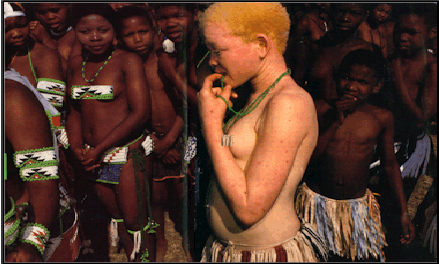
A twelve-year old albino boy was killed late yesterday by armed men in the central
Burundi district of Kiganda in what authorities suspect could be linked to witchcraft.
Albino hunters kill their victims and use their blood and body parts for potions. Witchdoctors tell their clients that the body parts will bring them luck in love, life and business.
“The twelve-year-old albino was killed by four men with guns and knives. They cut off his left hand and fled away with it,” Kiganda administrator Joseph Ntahuga, told Reuters today.
Ntahuga, a government official in the district 80 km from the capital Bujumbura, said the victim had two other albino siblings.
The murder brings to 14 the number of albinos killed in the tiny central African country since 2008.
The coffee producing nation of 8 million people has around 500 albinos, who lack pigment in their skin, eyes and hair.
Burundian authorities believe the killings are carried out local residents who work with witchdoctors in neighbouring Tanzania, where 53 albinos have been killed since 2007 for their body parts, which are sold for use in witchcraft. There are around 170,000 albinos living in Tanzania.
Kazungu Kassim, head of the national association of albinos, says albino killings continue in Burundi because severe punishment is not taken against the perpetrators.
“The solution is to sentence those responsible for albino killings to hang as it is done in Tanzania,” he said.
A man has been sentenced death by hanging for killing a five-year-old albino girl in Tanzania by hacking off her legs with a machete and then drinking her blood.
Pamela Anderson advert too racy for HK airport

Undated screen grab released by People for the Ethical Treatment of Animals (PETA) on December 29, 2010 shows actress Pamela Anderson in a security guard outfit playing a role in the animal rights advertisment ‘Cruelty Doesn’t Fly.
An animal rights commercial starring former Playboy centrefold Pamela Anderson, which is banned at some US airports, has been deemed too racy for Hong Kong, one of Asia’s busiest aviation hubs.
The advertisement, titled “Cruelty Doesn’t Fly”, features the scantily-clad former “Baywatch” star as an airport security guard who strips passengers of leather, fur and other skins.
A couple, seen nude from behind, also appears in the video commercial created by People for the Ethical Treatment of Animals (PETA).
“Given the groping that you see at security checkpoints and the nudity that you see in body scans we’re surprised that our lighthearted ad was deemed too risqué,” said Jason Baker, PETA Asia’s vice president.
The animal rights group said its ad was vetoed by JCDecaux, the advertising agency responsible for airing videos at Hong Kong’s airport.
In a statement, the city’s airport authority said the commercial was “considered inappropriate” because it might offend some visitors.
The ad – which also features comedian Steve-O, a star of the “Jackass” movie series, and German punk icon Nina Hagen – is already banned at airports in New York City and Boston, PETA said.
The animal rights group said it is still hoping to run the ad in other Asia-Pacific airports, including Tokyo, Seoul and Sydney.
North Korea again calls for end to confrontation with South

South Korean Army soldiers patrol along a seashore at sunset during a photo opportunity in Dangjin, southwest of Seoul.
North Korea called for end to confrontation and emphasised the need for dialogue with the South in a joint editorial published today by official newspapers, repeating the line from a year ago in the wake of clashes in 2010.
“Confrontation between north and south should be defused as early as possible,” said the joint editorial by three main official newspapers, carried by the KCNA news agency.
“Active efforts should be made to create an atmosphere of dialogue and cooperation between north and south by placing the common interests of the nation above anything else.”
But North Korea failed to make any detailed offer for talks and the rhetoric was largely along the line from a year ago, when the editorial said: “National reconciliation and cooperation should be promoted actively.”
Tensions between the rival Koreas have reached some of the highest levels since their 1950-53 Korean War in 2010, when the North shelled an island in the South killing four people.
South Korea and its allies also blamed the North for torpedoing one of the South’s navy ships in March, killing 46 sailors. Pyongyang denies the charge.
Car bomb hits church in Egypt, 21 killed

The aftermath of a bomb blast in Egypt's northern city of Alexandria
A car bombing outside a church killed 21 people in Egypt’s northern city of Alexandria as worshippers gathered to mark the New Year, security and medical sources said today.
The Interior Ministry earlier said 24 people were also wounded in the bombing, which prompted hundreds of Christians to take to the streets in protest. Some Christians and Muslims pelted each other with rocks, a witness said. Cars were torched.
Christians in Muslim-majority Egypt make up about 10 per cent of the nation’s 79 million people.
Egypt, due to hold a presidential election in September, has stepped up security around churches, restricting cars from parking directly outside them, after an al Qaeda-linked group in Iraq issued a threat against the church in Egypt in November.
The al Qaeda-linked Islamic State of Iraq, which claimed an attack on a church in Baghdad in November, threatened the Egyptian church over its treatment of women the group said the church was holding after they had converted to Islam.
“This is a scene from Baghdad,” a witness said by telephone.
Police used teargas to disperse the crowd on the streets. Ambulances were also at the scene where medical personnel gathered body parts that were scattered over the area.
“We sacrifice our souls and blood for the cross,” shouted protesting Christians near the Coptic Orthodox church where the blast struck, a witness said.
A statement from the Interior Ministry said the blast occurred just after midnight in front of the church after a service to mark the New Year. It said the blast damaged a mosque near the church and eight Muslims were among the 24 wounded.
Security and medical sources said 21 people were killed.
The ministry said an investigation had begun.
“The preliminary investigation indicates that a car was the reason behind the explosion. It was parked in front of the church and had been assumed to belong to one of the people who often come to the church,” said the ministry statement, which was read to Reuters by a ministry official.
Kameel Sadeeq, from the Coptic council in Alexandria, told Reuters: “People went in to church to pray to God but ended up as scattered limbs. This massacre has al Qaeda written all over, the same pattern Qaeda has adopted in other countries.”
In November, hundreds of Christians clashed with riot police, as well as some Muslims who joined in, during a protest over a decision to halt construction of a church. Officials said the church did not have a licence to be built.
Two Christians died as a result of those clashes and dozens were hurt, medical sources said. More than 150 were detained.
Analysts say the state must address grievances such as those over laws making it easier to build a mosque than a church if it wants to stem such sectarian violence.
Officials are swift to play down sectarian differences and are particularly sensitive to emphasise national harmony after a a parliamentary election in November that opposition groups said was rigged and before the presidential poll.
President Hosni Mubarak, 82 and in power since 1981, is expected to run again, if he is able. Gallbladder surgery last March rekindle questions about his health, although he has returned to a full schedule.
Pope to hold peace summit with religious heads

Pope Benedict leads his first mass of the New Year in St Peter’s Basilica at the Vatican today, January 1, 2011. Benedict will host a summit of world religious leaders in Assisi in October to discuss how they can promote world peace
Pope Benedict, worried over increasing inter-religious violence, will host a summit of world religious leaders in Assisi in October to discuss how they can better promote peace, he announced today.
Benedict told pilgrims and tourists in St Peter’s Square the aim of the meeting would be to “solemnly renew the commitment of believers of every religion to live their own religious faith in the service of the cause for peace”.
He made the announcement hours after a bomb killed at least 17 people in a church in Egypt in the latest attack on Christians in the Middle East and Africa.
The Assisi meeting will take place on the 25th anniversary of a similar encounter hosted by the late Pope John Paul in 1986 in the birthplace of St Francis.
That meeting was attended by Muslim and Jewish leaders and heads of many other religions, including the Dalai Lama, the spiritual leader of Tibetan Buddhists, and the Archbishop of Canterbury.
John Paul called on all nations and groups in conflict to silence their weapons during the meeting. Most groups adhered.
A main theme of the 1986 summit was the public repudiation of the concept of violence in the name of God.
“Humanity ... cannot be allowed to become accustomed to discrimination, injustices and religious intolerance, which today strike Christians in a particular way,” Pope Benedict said in his New Year’s Day homily to 10,000 people in St Peter’s Basilica on the day the Church marks its World Day of Peace.
“Once again, I make a pressing appeal (to Christians in troubled areas) not to give in to discouragement and resignation,” he said.
Hours earlier, in the northern Egyptian city of Alexandria, a bomb at a Coptic Christian church killed at least 17 people and wounded 43 as worshippers gathered to mark the New Year. The Egyptian Interior Ministry said it may have been the work of a foreign-backed suicide bomber.
The attack in Muslim-majority Egypt was the latest against Christians that has worried Church officials.
On Christmas Day, six people died in attacks on two Christian churches in the northeast of Nigeria, Africa’s most populous nation, and six people were injured by a bomb in a Roman Catholic Church on the island of Jolo in the Philippines.
In a message issued last month for the January 1 peace day, the pope said Christians were the most persecuted religious group in the world today and that it was unacceptable that in some places they had to risk their lives to practise their faith.
In November, 52 hostages and police officers were killed when security forces raided a Baghdad church to free more than 100 Iraqi Catholics captured by al Qaeda-linked gunmen.
The Vatican fears that continuing attacks, combined with severe restrictions on Christians in countries such as Saudi Arabia, are fuelling a Christian exodus from the region.
Subscribe to:
Comments (Atom)

